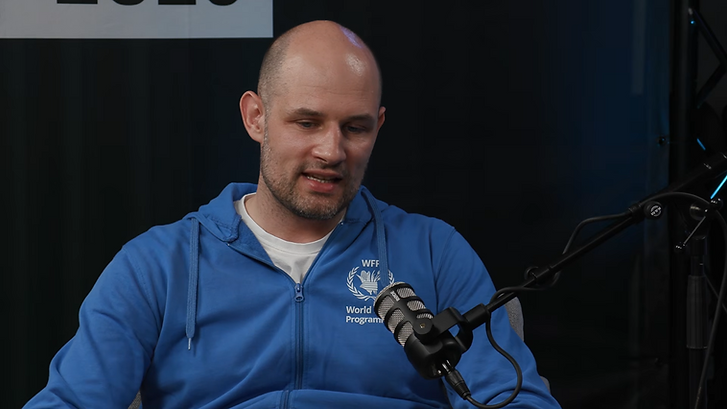
Darko Petrovic of the UN World Food Programme speaks to Good Game Club about gaming’s humanitarian potential, the fight against hunger and why game developers could be lifesavers.
By Jude Ower
The United Nations World Food Programme (WFP) is turning to the global games industry to help people understand the systems driving hunger, as it, in partnership with non-profit Games for Change, launches a new campaign encouraging the gaming community to engage with one of the world’s most complex humanitarian challenges.
For Darko Petrovic, who leads WFP’s engagement with gaming within its Private Sector Partnerships Division, games can move beyond entertainment to help people understand complex food systems, build empathy and mobilise resources for humanitarian action. “The world needs more gamers,” he says. “Your games can be a lifesaver for someone.”
In our conversation, Darko reveals that his connection with gaming is deeply personal. Four years ago, while on humanitarian assignment in Barbados, he was diagnosed with a rare form of blood cancer. During long periods in hospital and isolation, mobile games helped him cope and stay connected with friends. The experience inspired him to explore how games could support people facing humanitarian crises.
Now, with WFP looking to deepen its relationship with the games industry, Darko believes studios and developers have much more to offer than fundraising alone.
This interview with Darko Petrovic – hosted by Jude Ower - has been edited and condensed from the original Good Game Club podcast for length and clarity.
You've worked on the humanitarian front line, working with an NGO. How do you go from that to believing that video games can play a role in the fight against hunger?
These are two different stories I would say that at some point have actually met in a miraculous way. On the one hand, I have joined this profession, after finishing my degree and was able to really witness the hardship in many different places in the world and what it means to be hungry, and what it means to not have access to food or to healthy food.
On the other hand, I'm a I'm a very playful person by character. Games and play have been a very important part of my life for most of my life. As a child, you are this is your job. You know, you play because you learn stuff. This is how you navigate environment, how you survive often.
And for me, games and play have not been, you know, only that - they have been really a form of survival because I was going through very adverse situations in life from a broken home in which there was a lot of, you know, fighting and where you have to be the diplomat, where you have to kind of be funny - games and play help you survive that adversity.
And then further to work. You know, when you are in a humanitarian setting, it's tough. It requires a lot of resources. Sacrifice. You're far away from your family, sometimes for months or from for years.
And games and play again have been this this tool, this way of coping with stress, connecting with colleagues and dealing with adverse situations.
And then the final one and I think what really brought me here and into this chair is the last experience I had when I actually got cancer. That was four years ago. I was in a mission in Barbados. I was diagnosed out of the blue with a rare form of blood cancer. I spent a lot of time alone in hospital and in an isolation ward. What I did, I played games, I played games again, video games, mobile games in this sense, which helped me to connect with my friends who were living in different countries or elsewhere in the city.
And this light bulb moment came: ‘Oh, this is interesting, what can we do?’ Games have evolved so much in so many years. This can be used for another purpose, beyond entertainment. Can we use this for WFP for fighting hunger?
And this is actually where things met, the passion of helping people working in a humanitarian domain, saving the world, right? And then being all playful and gamey, bringing those two passions together was just this phenomenal moment. I know from hands-on experience how important games can be for your own survival. So why not use this for the survival of people that we assist in all those different places we work in?
Thank you for all your passion and energy that you put into the World Food Program and the games industry as well - the world needs more Darkos.
The world needs more gamers. When I come across gamers and game designers at Gamescom or anywhere. People say, ‘Oh, you work for the UN, wow, this is incredible, I do only games.’ I tell them, ‘No, no, no, no, no, you don't do only games - like your games can be a lifesaver for someone, right?’ They can save lives. They can change lives through developing skills. Opening opportunities. Building social cohesion around the community. Helping you cope with adversity. With a war. With an earthquake. Games have so much to offer, to make this world a better place. So, I would always encourage them to think higher than this.
Tell us about WFP's new Game the Food System initiative. Why is it needed?
Game the Food System is an initiative that we are planning to launch in October. It's a campaign that is inviting game designers, players, people who are managing jams, game jams to use that theme to design games around that theme, to integrate this theme in games as part of stories, and also to work with us to help us transform food systems around the world.
Hunger right now is on the rise. We had Covid, which had massive supply chain shocks around the world. We have now the conflict also in the Gulf, which has massive supply chain shocks. We have climate change. We have now El Nino, which is historic in proportion.
Hunger has been rising to about over 300 million people who are acutely suffering hunger. And then at the same time, you also have about 1 billion people who are overweight or obese in the world. So, these two facts coexist.
And, you know, this is not now obviously an issue of food availability. It's an issue of food distribution, of the efficiency of the food system. It's a matter of production, of transport, of trade, of storage, of preparation, of consumption, of waste management.
So many different elements of the food system are relevant for this.
Our food production, our food relies on a healthy planet. And right now, the way the food is produced is not sustainable. Neither for the planet nor for the people. So, it's important to game the food system, to protect the planet, to protect the people, to ensure a sustainable food future.
So, we are encouraging game jams which are organized or game designers, companies who want to be part of this campaign to integrate these themes, to talk about this with their employees, with their community, and to actually take action to game the food system in their own life after they have designed or played around this.
How would a game studio get involved, how do you imagine it working?
There are different ways to get involved. We will have more information online coming soon. One of the main ways is if you're a game jam, let's say organizer is to invite players to use that theme, right? And to submit games around that theme to your game jam. With studios, it's about also working directly in partnership with WFP, where we can provide the expertise on this topic.
If you want to help us game the food system and, you know, talk about these issues, for us to provide you with this information and for us to partner together to integrate stories within existing games, but then also to support us with, you know, raising funds for the food transformation projects we have in Africa and Asia and Latin America which are transformative but massive scale. What we do in that area, it's not about tree planting, it's actually about ecosystem restoration, so that you stabilize populations, you stabilize food security supply chains and you bring biodiversity back to life at the same time.
Can you give me more insight on other things that you’ve been working on in the World Food Program that involves games?
So maybe I can say a few things that what we did, like the WFP gaming journey. We have been in this space for, believe it or not, over 20 years. We have started in 2005 with an educational game called Food Force. That was like a very successful experience to educate about the role of a humanitarian in a crisis zone. You could fly a helicopter, provide food, do different missions. Exciting. Very successful.
Farmville was one of the pioneering partnerships we had around the Haiti earthquake in 2010, where we worked with them to have white corn seeds in the game that could be purchased through Facebook. This was that social media moment that was brilliant, on which we built later and many others did as well.
That also led to the Ukraine fundraiser with many companies coming, joining together.
We did games for training. And we also used games to actually inform program design. In the areas of financial literacy, nutrition education and the area of micro insurance, in the event of weather hazards, we actually used games to interact with local communities for them to understand these concepts and for us to get feedback about the program in a fun and productive way, not just through a standard workshop.
We had 30 plus initiatives in 20 years. But they have all been scattered. And so now what we did, what has changed in the last couple of years when I came into this, after the hospital experience was to build a strategy and to connect the dots and to elevate this to a level that can allow us to work with the industry in a much more effective way, efficient way, sustainable way.
Not just a one-off, but really something more long term. You know, partners want to and to connect the dots internally to not also waste resources. Right. So to keep things stable and to keep things going and to grow them. That's the whole premise of this current approach. Um, what we would love to do now, of course, you know, mobilizing resources is very important for WFP in this world in which we live.
Mobilizing resources, funding, technology, talent, know-how from gaming, that would be a key pillar. The other one is storytelling - through games, through game designs, through game jams: how can we tell the story of hunger, of food systems in a way that is actually uplifting and hopeful and gives people agency to be part of the solution, not just, ‘Oh, everything is so bad, you know? Please click here to donate.’ No. Of course, we have to tell those stories that are authentic, that are bad, that are heartbreaking. But there's also space to tell stories about resilience, about resourcefulness, about hope. So that's we want to leverage games for storytelling and of course, education, training, upskilling all these things.
They are still important. They are context specific, led by teams in the field. And I'm helping them connect dots. What I would love to see, honestly, in terms of back to your question, what I guess I haven't seen really much happening is inviting gamers into our organization.
I had conversations with colleagues who actually had worked with game designers who are game designers by profession, but they also worked for us to do, I don't know, data analytics or programming or coding or different things.
And they were very impressed by the skill set that they brought with them and what the level of efficiency and, and expertise and, and new ideas that they brought in to make our internal ways of working better.
My kind of dream would be to also build a pipeline, a talent pipeline that would come from the gaming industry to WFP to, you know, not just fill, you know, empty positions. But really to help us do things differently and do things in a more creative way, do things in a way that can resonate with people.
Use this talent, use this skill set in many areas, right? Animation. Storytelling. Graphic design. UX. Programming. Coding. There's just so much out there.
At a time right now where we have those resource constraints, if we can find partners in the gaming industry who can help us bring talent to us through some kind of fellowships or some kind of secondment or whatever internships. At WFP, they will find a home.
You look at what’s happening with gaming and NGOs, different systems leveraging games, are there any that stand out that have worked well?
I think what has worked well are collaborations where there has been alignment from the very beginning between the charity or the organization, the impact organization and the gaming studio and their community. If from the very beginning there is a co-creation process that actually yields common objectives and how you implement it, that there is input also from the players - these experiences are precious, right?
And they are not easy. At the same time, they take time. It's not something you can just build from one day to the other. There's a lot of trust-building involved, a lot of relationship-building involved, a lot of mutual discovery. Understanding of player’s needs, involving them in that, not just assuming what they want, but really also seeking out feedback that works well and vice versa. If it's not done that way, then things you know will collapse fairly quickly.
Do you think that play can really help a generation understand hunger and then understand what can be done to solve it?
Absolutely. I think understanding hunger, you can just do one experiment. Very simple. Just don't eat today. Just don't eat. Don't eat until the end of the day. Until tomorrow. Until the end of the week. I'm sure you will notice. You will understand very quickly what hunger means, right?
A thing that I always, you know, say to people is you cannot learn, play or thrive on an empty stomach. Like you can do all kinds of educational initiatives. You want physical activity, sport introduced because this is good for mental health or for economic development or, you know, social development, but people who are hungry cannot participate. They are excluded. So, there is an inclusion issue here.
Food is such an essential ingredient for so many social, economic and development dividends that we have that we just can't imagine this otherwise.
In terms of gaming and play and game design, I think especially game design has this quality that it's promoting system-thinking. So, if you want to understand food systems, what are the root causes of hunger, how it comes to be, how it manifests, the different consequences of it. The different dilemmas involved, decision points. You can find all this in a game. So, if you design a game, when you think about the system and the mechanics of the real world and you want to put them in a game, then you also understand the mechanics of the real world.
And if then you take these learnings outside and implement this in the real world through your own school project or employee engagement activity, then you understand even more what it means. I think games, because of that system, nature of system thinking, of holistic decision points, of trial and fail, games have a very high pedagogical potential. So, people can understand this from a system level. And that's what we need. I think that's also what the campaign is, in essence, all about - helping people understand food systems, why they are so critical, why they are inter-dependent with ecosystems, and to do something about it.
And food system is not an easy concept. You have to unpack it. There are so many different phases to it. So, through game design, being involved in this experience in a game jam or playing a game that tackles this issue in a very smart way, you can learn the different aspects and you can have the ‘Aha!’ moment and you can relate to it in your real world and say, ‘Oh, so I can do this also in my real life.’
Watch or listen to the full conversation with Darko Petrovic on the Good Game Club podcast here Good Game Club Podcast - YouTube.